Redactys
Building a complete vertical AI product with a psychomotor therapist, from session notes to online payment: a writing assistant for psychomotor assessment reports.
visit sitethe context.
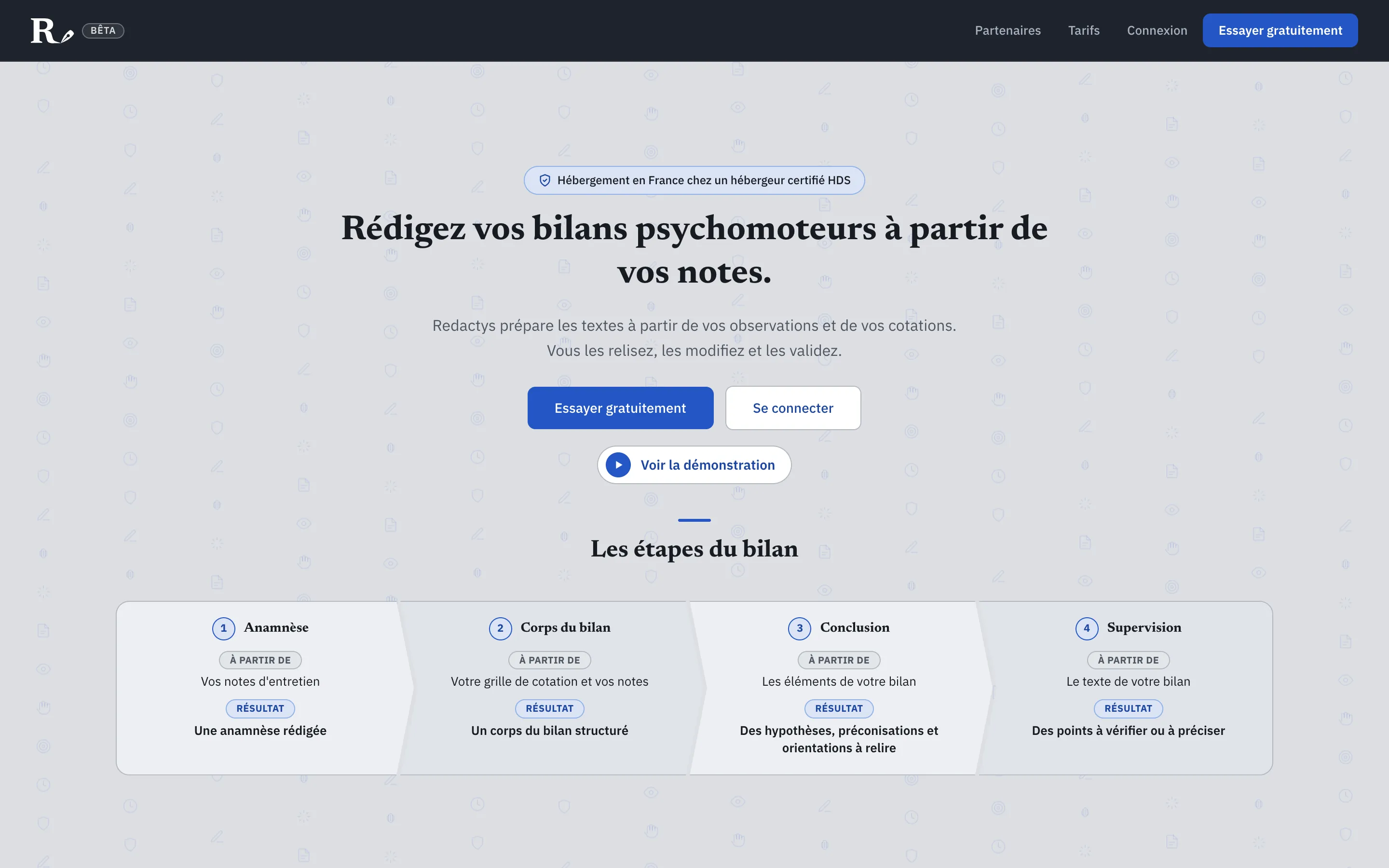
For a psychomotor therapist, the assessment report is a central document, and writing it takes time. Aude Le Grelle, a psychomotor therapist in private practice, was spending more than 4 hours per report, eating into her evenings and weekends. Redactys was born from that, and I built it with her: she brings the clinical expertise and her feedback on the reports, Obrentis designs and develops the product.
The subject came with one non-negotiable requirement: confidentiality. This is health data, about children, in clinical write-ups. The architecture had to guarantee, by design, that no patient content is readable on the server side, and to say so with the right words: pseudonymised, not anonymised.
what I built.
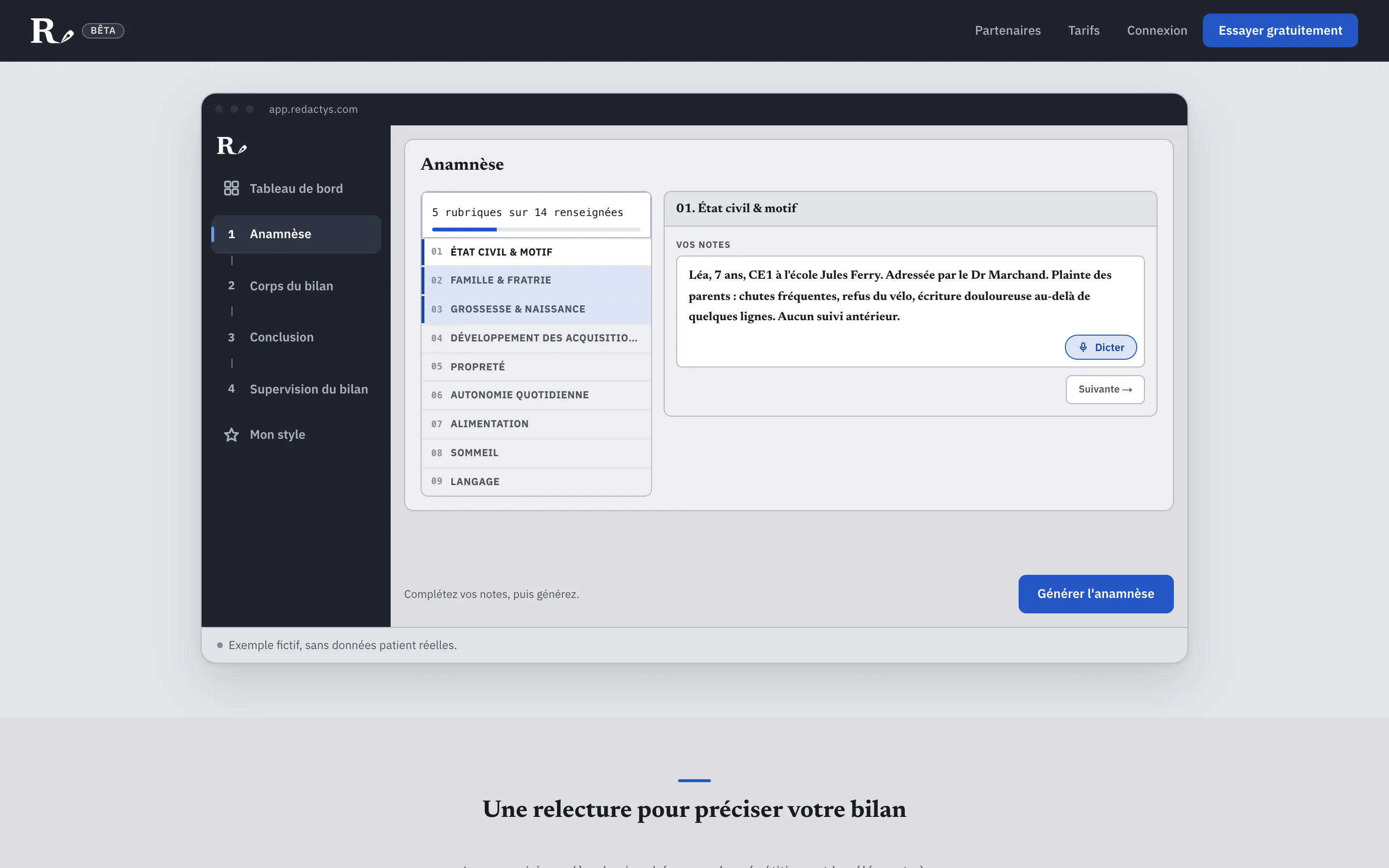
The product follows the practitioner's actual workflow in four modules: the anamnesis, which turns interview notes (typed or dictated) into written text; the body of the report, built from the scoring software's PDF export, read in the browser without AI; the conclusion, with hypotheses and recommendations; and the supervision, which reviews the report and flags what needs nuancing, clarifying or is missing. The full report exports to Word.
Confidentiality is built into the architecture. Before anything is sent to the AI, names, dates and places are detected and replaced in the browser, by a named-entity model running locally plus regular-expression safety nets, and the practitioner checks the flagged items. Saved reports are encrypted on the device with a key derived from the practitioner's password, then stored in France with an HDS-certified host: Redactys cannot open them. Writing runs on Claude through Amazon Bedrock, in the Paris region.
Around the product, I built a complete SaaS model: credits and subscriptions with Stripe payments, RPPS number verification at sign-up, referrals, a recommendation programme, and a widget that healthcare software vendors embed in their web application, billed by usage. All of it in Next.js and Supabase, hosted on AWS in Paris.
The project is live: redactys.com.
key features of the project.
Writing tuned to the practitioner's style
Sample reports, writing guidelines, and an 'Analyse my corrections' button that suggests new guidelines to keep or discard. Not generic AI-assistant prose.
Test scores read without AI
The scoring software's PDF export is read in the browser by a deterministic parser, without the patient header. MABC-2, MABC-3 and BHK grids are built in, and a handwritten MABC record form can be read from a cropped photo.
A supervision that reviews the report
Points to nuance, missing items, vague claims, repetitions, an initial complaint never addressed in the conclusion: the supervision flags, the practitioner decides.
In-browser pseudonymisation
Names, dates and places replaced with neutral tags before anything is sent, using a recognition model that runs locally. Flagged items are shown to the practitioner for review.
Encrypted reports, hosted in France
Encrypted on the device with a key derived from the password and backed up with an HDS-certified host: practitioners find them on all their devices, Redactys cannot read them.
A complete SaaS model
Credits, subscriptions, online payment, RPPS verification, referrals and a usage-billed widget for healthcare software vendors.
a project in mind?
Describe your need in one sentence. I'll tell you if it's doable, and what it costs.